


Machine Learning · MLOps · Enterprise AI
Machine learning pilots are relatively easy to demonstrate. Turning them into reliable systems that continuously support real business operations is much harder.
A model may perform well in a notebook, proof of concept, or controlled test environment, yet production introduces an entirely different set of requirements: live data, security controls, integrations, infrastructure, latency, monitoring, governance, changing business conditions, and operational ownership.
This is where many machine learning initiatives encounter their biggest challenge.
The objective is no longer simply to build a model.
The objective is to build an operational AI system around the model.
For enterprises investing in machine learning, the transition from experimentation to production requires engineering discipline, strong architecture, MLOps, continuous evaluation, security, and clear business ownership.
The Gap Between an ML Pilot and Production
During a pilot, teams are usually trying to answer a relatively simple question:
Can machine learning solve this problem?
They may train several models, evaluate them against historical data, demonstrate predictions through a dashboard, and prove that the idea has potential.
Production changes the question:
Can this solution operate securely, reliably, and continuously inside the business?
A production system must handle much more than model inference.
It may need to:
- Collect data from operational systems
- Validate and transform incoming data
- Generate model features consistently
- Serve predictions through applications or APIs
- Authenticate users and services
- Integrate with enterprise workflows
- Monitor model and system performance
- Detect failures and abnormal behavior
- Track model versions
- Support rollback
- Protect sensitive information
- Maintain auditability
- Retrain or replace models when conditions change
The machine learning model becomes only one component within a much larger production architecture.
Why Promising ML Pilots Struggle in Production
Several recurring problems prevent organizations from moving successfully from experimentation into operations.
1. The Model Was Built Without the Production Environment in Mind
A data science team may create an accurate model using historical datasets without fully considering how the model will receive the same information in production.
This can create a gap between training and inference.
Production architecture should therefore be considered early.
Teams need to understand where data originates, how frequently it changes, how predictions will be consumed, what latency is acceptable, and which applications need integration.
2. Data Changes After Deployment
Machine learning depends heavily on data.
Customer behavior changes. Products change. Transactions change. Business processes change. External conditions change.
As production data begins to differ from the data used during development, model performance can deteriorate.
Organizations therefore need visibility into both data quality and model behavior, not simply whether an API is online.
3. Models Are Deployed Without Sufficient Observability
Traditional application monitoring asks questions such as:
Is the service running?
What is the response time?
Are requests failing?
Machine learning introduces additional questions:
Is the model still performing as expected?
Has the input distribution changed?
Are predictions becoming less reliable?
Which model version produced this prediction?
Are certain segments behaving differently?
Production ML requires infrastructure observability and model observability together.
4. Integration Is Treated as an Afterthought
A prediction has little business value if nothing can act on it.
A fraud model may need to interact with transaction systems.
A churn model may need to connect with CRM and customer engagement platforms.
A forecasting model may feed planning or inventory systems.
A risk model may need to trigger a human review process.
The value of machine learning is realized when predictions become part of real operational workflows.
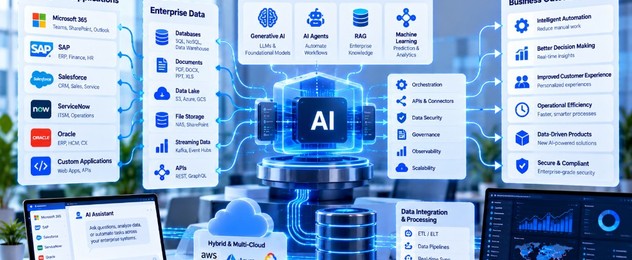
The Production ML Architecture
A mature machine learning environment typically contains several connected layers.
Data Layer
Production models require reliable access to the data they depend on.
This can include:
- Operational databases
- Data warehouses
- Data lakes
- APIs
- Streaming platforms
- Enterprise applications
- Files and documents
- External data sources
Data pipelines must ingest, validate, transform, and prepare this information consistently.
Model Development and Evaluation
Data scientists and machine learning engineers need controlled environments for experimentation.
This includes model training, feature engineering, experiment tracking, validation, comparison, and evaluation.
The goal should not simply be selecting the model with the highest experimental score.
Teams must also consider factors such as operational cost, latency, explainability, maintainability, scalability, and risk.
Model Registry and Versioning
Production teams need to know exactly which model is deployed.
A model registry can help maintain:
- Model versions
- Evaluation results
- Deployment status
- Model artifacts
- Approval information
- Relevant metadata
This creates traceability between experimentation and production.
Deployment and Serving
Once approved, models need a controlled path into production.
Depending on the use case, predictions might be delivered through:
- Real-time APIs
- Batch processing
- Event-driven systems
- Streaming pipelines
- Embedded application services
Containerization, automated deployment pipelines, infrastructure automation, and controlled release strategies can make deployment more repeatable.
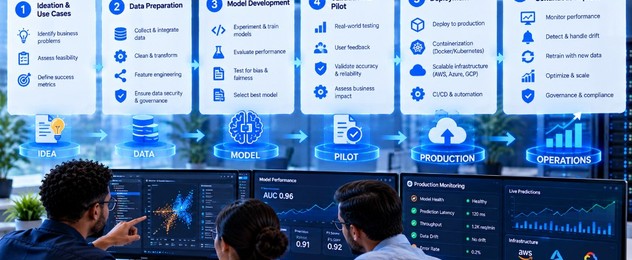
MLOps Connects Development and Operations
MLOps applies software engineering and operational practices to the machine learning lifecycle.
A mature workflow may look like:
Data → Train → Evaluate → Approve → Deploy → Monitor → Improve
Automation can be introduced throughout this lifecycle.
For example, a deployment pipeline can validate model artifacts, execute tests, perform security checks, deploy to a controlled environment, validate behavior, and then promote an approved version to production.
The goal is not automation for its own sake.
The goal is to make machine learning delivery repeatable, observable, governed, and recoverable.
Evaluation Must Continue After Deployment
Model evaluation should not end when the model reaches production.
Organizations should establish baseline performance before deployment and then continuously compare production behavior against expected results.
Depending on the application, monitoring may include:
- Prediction quality
- Data drift
- Concept drift
- Feature distribution
- Error rates
- Latency
- Throughput
- Resource utilization
- Business KPIs
The correct metrics depend on the business problem.
For example, monitoring a recommendation model is different from monitoring a fraud-detection system or demand-forecasting model.
Technical metrics and business metrics should therefore be considered together.
Build for Failure and Rollback
No production system should assume that every deployment will work perfectly.
Machine learning systems need a recovery strategy.
Before releasing a new model, teams should know:
What happens if performance deteriorates?
Can we restore the previous model?
Can the application continue without ML predictions?
Who decides when rollback is necessary?
How quickly can the change be reversed?
Versioned deployments, staged releases, fallback mechanisms, and rollback procedures reduce operational risk.
For higher-risk use cases, human review may remain part of the workflow even after automation is introduced.
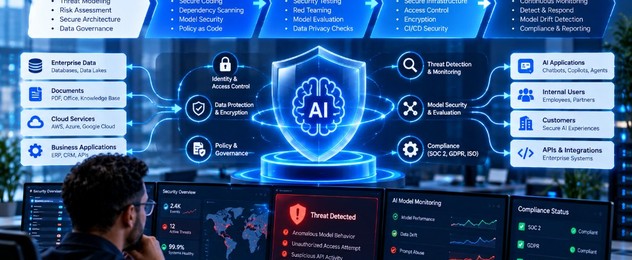
Security Must Extend Across the ML Lifecycle
Production machine learning expands the attack surface beyond the model itself.
Organizations need to consider the security of:
Data → Development → Models → Pipelines → APIs → Infrastructure → Applications
Controls may include identity and access management, secrets management, encryption, network segmentation, API security, logging, vulnerability management, data protection, and least-privilege access.
The objective is to treat ML as part of the enterprise technology environment rather than as an isolated data science project.
Governance Creates Accountability
As machine learning becomes embedded in business decisions, organizations also need clear governance.
Important questions include:
Who owns the model?
Who approves production deployment?
Which data was used?
Which version is currently running?
How was the model evaluated?
How are significant changes reviewed?
When should human intervention occur?
Governance does not have to mean creating unnecessary bureaucracy.
Effective governance establishes ownership, traceability, controls, and decision-making processes appropriate to the risk of the application.
Human Oversight Still Matters
Not every decision should be completely automated.
For sensitive or high-impact processes, machine learning may be more valuable as a decision-support capability.
A model can identify patterns, prioritize cases, calculate risk, or make recommendations while humans retain authority over important decisions.
This creates a practical relationship:
Machine Intelligence + Business Rules + Human Judgment
The appropriate level of automation should depend on the use case, risk, confidence, and business requirements.
Measure Business Outcomes, Not Just Model Accuracy
A technically impressive model is not automatically a successful production system.
Organizations should connect machine learning performance to measurable operational outcomes.
Depending on the use case, these might include:
- Reduced processing time
- Improved forecasting
- Faster fraud investigation
- Better resource allocation
- Lower operational cost
- Higher automation rates
- Reduced manual workload
- Improved customer experience
- Faster decision-making
This shifts the conversation from:
“How accurate is our model?”
to:
“What measurable business outcome is this system improving?”
That distinction is fundamental to enterprise AI.
A Practical Path from Pilot to Production
Organizations can approach productionization through six stages.
1. Define the operational outcome
Identify the business problem, expected outcome, success metrics, users, and operational owner.
2. Establish data readiness
Validate data quality, accessibility, security, lineage, and production availability.
3. Design the production architecture
Define model serving, integrations, infrastructure, security controls, scalability, and failure handling.
4. Establish evaluation and release criteria
Determine what technical, business, security, and operational conditions must be satisfied before deployment.
5. Deploy with monitoring and rollback
Release through controlled deployment processes with observability, versioning, alerting, and recovery mechanisms.
6. Continuously optimize
Use production evidence to improve models, pipelines, infrastructure, cost, and business performance.
From Machine Learning Experiment to Enterprise Capability
The organizations that generate lasting value from machine learning are not simply those that build sophisticated models.
They are the organizations that develop the engineering and operational capabilities required to run those models reliably.
That means connecting:
Machine Learning + Data Engineering + MLOps + Cloud Infrastructure + Security + Governance + Enterprise Integration
When these disciplines work together, machine learning can move beyond experimentation and become part of everyday business operations.
How Neural Xpert Helps
Neural Xpert helps organizations move machine learning and AI initiatives from experimentation into secure, production-ready environments.
Our work spans machine learning engineering, data and enterprise integration, cloud and AI infrastructure, MLOps, observability, security, governance, deployment, and continuous optimization.
Whether an organization is validating its first machine learning use case or modernizing an existing production AI environment, the objective remains the same:
Build AI that can operate reliably in the real world.
Ready to Move Your AI Initiative Into Production?
Turn your machine learning pilot into a secure, scalable, and operational AI capability.